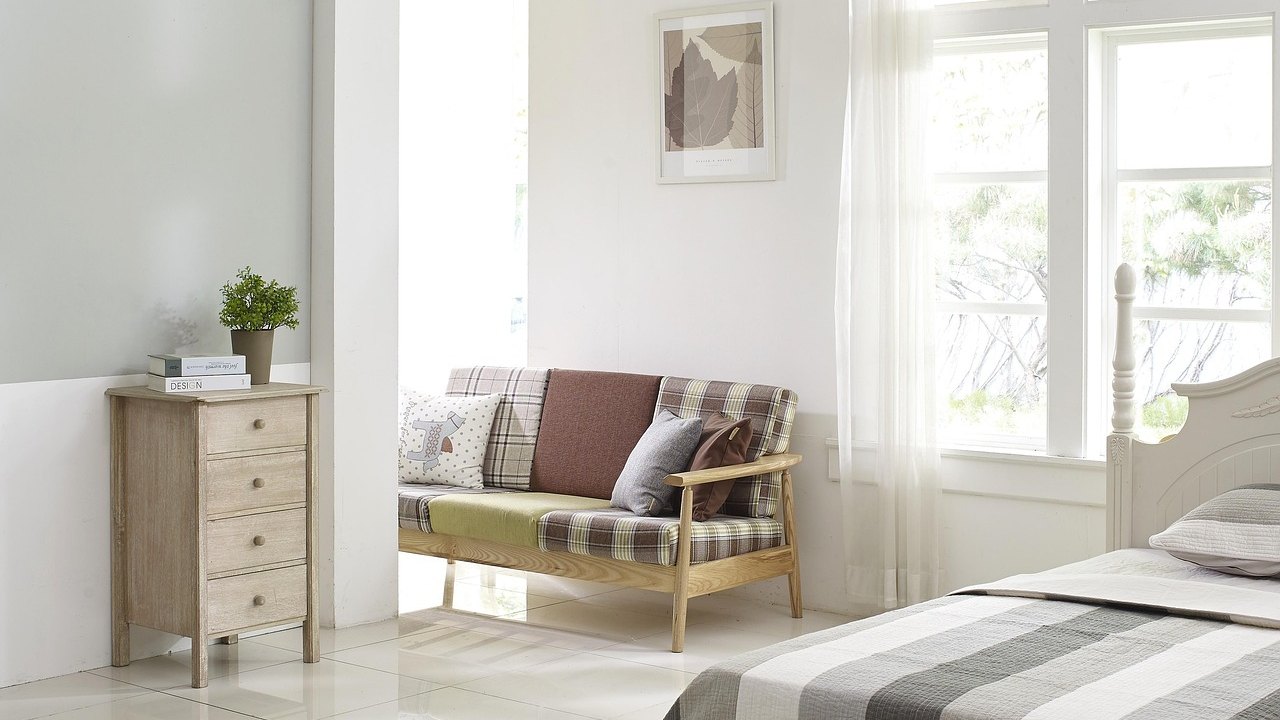
Twice a year, the house needs about two hours of attention. Once in spring, once in autumn. Not a deep clean, not a clear-out — a count.
The distinction matters because these two activities have opposite emotional structures. A clear-out is a series of decisions made under time pressure and a vague sense of guilt, and it leaves you tired and slightly ashamed. A count is a set of facts. Facts are cheap to collect and easy to act on later, in a better mood, with the window open.
What actually changes with the season
Four things, in order of how much they affect how a room feels.
The bedding. This is the one with a number attached. Duvets are rated in tog: 4.5 for summer, 9 for warm rooms, 10.5 for most of the year, 13.5 for cold bedrooms. The rating is a measure of thermal resistance, so it only means something relative to the room. A 13.5 tog in a bedroom at 21°C is the most common cause of a bad night's sleep in a well-insulated flat, and the answer is a lighter duvet rather than an open window.
The textiles at the window. Lined curtains closed at dusk cut heat loss at the glass by roughly a fifth. The detail that decides whether they work is not the fabric but the size: two times the window width so they hang in folds rather than flat, and long enough to reach the floor. A sill-length curtain leaves a gap at the bottom where cold air falls into the room, which is the exact gap a full-length curtain closes.
The floor. A wool rug in winter, something flat and washable in summer. This is partly warmth and mostly sound: a room with a rug and a room without one sound like different rooms, and the difference is more noticeable in winter because the windows are shut.
The objects on surfaces. This is the one people skip and it is the one that makes the change legible. Two objects swapped is enough. A stoneware vase in place of a glass one. A candle where the bowl was. The room reads as changed without anything being bought.
The count, in order
Do it in one room at a time, and do it in this order.
Empty one category, not the whole cupboard. Pull out all the wool, or all the bedding, or all the curtains. Not everything. A whole cupboard on the floor is a crisis; one category on the bed is a task.
Count out loud. How many blankets, how many duvet covers, how many pairs of winter curtains. The number is the point. Most households own roughly twice the seasonal textiles they can use, because these are the things people buy when they move and never audit again.
Wash before storing, always. Moths are not attracted to wool. They are attracted to the skin cells, hair and food traces in it. A wool blanket put away unwashed is a meal. Wash at the temperature on the label, dry completely, then store.
Store dry, sealed, and ventilated. A vacuum bag is fine for a duvet for a few months. It is not fine for wool, which needs to breathe and will hold a crease it never loses if compressed for a year. Cotton bags, cedar or lavender, and a dry cupboard.
Date the box. Write the month on it. When it comes out next season, you will know exactly how long it has been shut.
The number worth keeping
Keep one note, on paper or in your phone, of what you actually used this season.
Not what you own — what you used. The blanket that stayed on the sofa from October to March. The duvet that was too warm in November and too cold in February. The curtains that were never closed because they caught on the radiator.
That list is worth more than any amount of decluttering advice, because it is about your house, at your temperature, with your windows. Next autumn, buy against the list instead of against the shop.
Layering instead of switching
There is an alternative to owning three duvets and swapping them twice a year, and it is the one I would choose in a small flat.
Keep a single 4.5 or 9 tog duvet on the bed all year and put a wool blanket over it when the nights turn. On a mild October night the blanket folds back; in January it stays on. The adjustment is made per night rather than per season, which is more accurate, because the weather does not change on the calendar either.
The wool blanket does more work than a heavier duvet. Wool moves moisture away from skin and it holds heat without holding damp, so a blanket added on top keeps you warm without the clammy overheated feeling that a 13.5 tog gives in a well-insulated room. It also works on the sofa for eleven months of the year.
The saving in storage is not trivial. Three duvets at 10.5 tog and above occupy roughly 120 litres. One duvet and one blanket occupy about 40. In a flat where the airing cupboard holds the vacuum and the ironing board, that is the difference between a seasonal swap and a fight.
Every season, the two jobs worth doing
Wash the duvet and the pillows. A duvet needs washing two to four times a year and pillows every three months, and both are machine-washable at 60°C unless the label says otherwise. Pillows accumulate a surprising amount of skin and dust mite waste by weight — a five-year-old pillow can be a significant fraction of it — and they are washable far more often than people think.
Rotate the mattress. Turn a double-sided mattress 180 degrees every three months. A single-sided one can be rotated end-for-end but not flipped, and rotating is still worth doing: it spreads the wear from the sleeping position, which is what causes the dip. Vacuum it at the same time with the upholstery tool, and leave the bed unmade for an hour so the moisture from the night evaporates.
Neither job takes more than twenty minutes and both are invisible. That is the point: the seasonal change is not a decorative event, it is the maintenance that keeps the bedroom from becoming the one room nobody audits.
The thing not to do
Do not do this in a bad mood, and do not do it in one day.
A seasonal change done in a bad mood becomes a purge, and a purge removes things you will replace. Done in one day it becomes exhausting around hour three, and the last room gets the decisions the first room deserved.
Two hours, one room, one category, a written count. Then stop, put the kettle on, and leave the second room for next weekend. The house will still be there, and it will be slightly better counted.