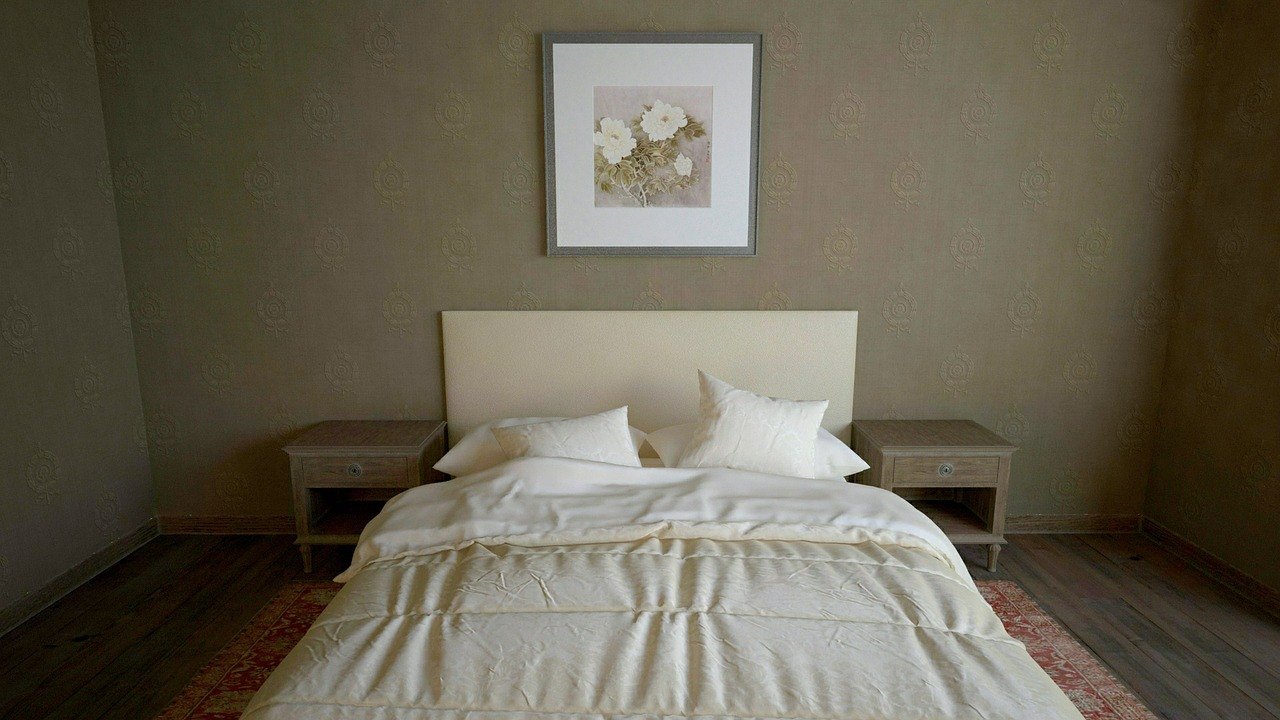
The bedroom is twelve square metres, which sounds generous until you put a bed in it. A double bed is roughly four of those metres, a wardrobe is another one and a half, and suddenly more than half the room is furniture shaped, not living shaped.
This is the room I kept re-arranging for two years. New bedside tables, a bench at the foot of the bed, a bigger wardrobe because the small one was always full. Every solution added a piece of furniture, and every piece made the room smaller. The turning point was not a purchase. It was counting.
The audit, done properly
I wrote down everything in the room, then everything I actually did in it. The list of activities was short: sleep, read for twenty minutes before lights out, put down the clothes I would wear tomorrow, charge a phone. Four activities. The room was holding eleven pieces of furniture.
The mismatch was the whole problem. The room was not too small — it was furnished for a life I was not living in it.
So I set a rule that felt severe at the time: every piece of furniture had to serve at least one of those four activities directly, or leave. The bed obviously stayed. The wardrobe went to the hall, where it should have been all along — bedrooms do not need to store clothes, flats do. The two bedside tables became one shelf. The bench at the foot of the bed, which only ever held yesterday's clothes, became a single chair.
What stayed, and what each thing does
Four pieces survived.
The bed, in the centre of the longest wall, with 60cm of walkway on each side. Less than that and you stop having a room and start having a corridor around a mattress.
One armless chair, oak, by the window. It is where I sit to take shoes off, where the next-day clothes wait over the back, and where I read on Sunday mornings. It is the only object in the room with any tolerance for clutter — a chair with clothes on it looks lived-in, while a bed with clothes on it looks like a problem.
The lamp, on the floor beside the bed. A warm bulb at 2700K, dimmable, with the shade at reading height. If I could keep only one non-bed object, it would be this one: the difference between a small room at night feeling calm and feeling cramped is almost entirely the light.
One shelf, oak, mounted on the wall at the height where your hand goes when you lie down and reach. It holds a book, a glass of water, the phone, and a multi-socket block for charging — taped to the underside, invisible from the bed. Four things, and a rule that nothing else is allowed to arrive.
The measurements that made it work
Four pieces of furniture is a decision. Where they go is arithmetic, and in a room this size the arithmetic has no slack.
A double bed is 140×200cm. Add a 60cm walkway on the side you get out of, and the bed plus its clearance is 2.6m across. In a 3.2m-wide room that leaves 60cm on the other side, which is enough to make the bed and not enough to walk past. So the bed goes against the longest wall, not centred, and the walkway is on one side only. Centring a bed in a small room looks balanced in a plan and is unusable in practice.
The door swing eats a square metre. A standard inward-opening door on a 90cm leaf sweeps about 0.8m². In a 12m² room that is seven per cent of the floor, permanently unavailable. Two options: take the door off and hang a curtain, or fit a door that opens outward into the hall. The second is better and nobody does it, because it looks wrong in a plan and works perfectly in a life.
Wall height is the only free space. A 12m² room with a 2.6m ceiling has 31m² of wall. The shelf at sitting-eye height — about 75cm from the floor when you are propped up — uses space that a bedside table cannot, and costs no floor at all. This is why the shelf replaced two tables and the room got bigger.
The wardrobe depth is what kills small bedrooms. A standard wardrobe is 60cm deep and 100cm wide, so 0.6m² of floor and a 100cm block of wall you can never put anything else against. Moving it to the hall did not reduce storage; it moved storage to the room that had slack. Hallways are wide and under-used, and a bedroom is neither.
One thing I got wrong first: I bought a floor lamp, then discovered that a floor lamp beside a bed is a thing you have to reach past at night. A wall-mounted reading light at 110cm, or a lamp on the shelf with a flexible arm, is the same light in a place that does not compete with the bed. The floor lamp went to the living room and was better there.
What the room gained
Twelve square metres with four pieces of furniture holds something that a fully furnished one never did: emptiness that reads as calm rather than as unfinished. There is a metre of bare wall on two sides of the bed, and that bareness is the design. It is the thing people comment on when they first walk in — not the furniture, the space.
The honest cost: the hall now carries the storage, and getting dressed means leaving the room. In a flat this size that is fifteen steps. I had thought of that as a flaw for the first month. Now it reads as a boundary — the bedroom holds rest, and everything else has to go and live somewhere else. That boundary does more for sleep than the mattress did.
There is a second-order effect nobody warns you about. When a room can only hold four things, you stop being tempted by the fifth. The furniture itself imposes the discipline that my willpower never could. I have not thought about bedside tables in two years.