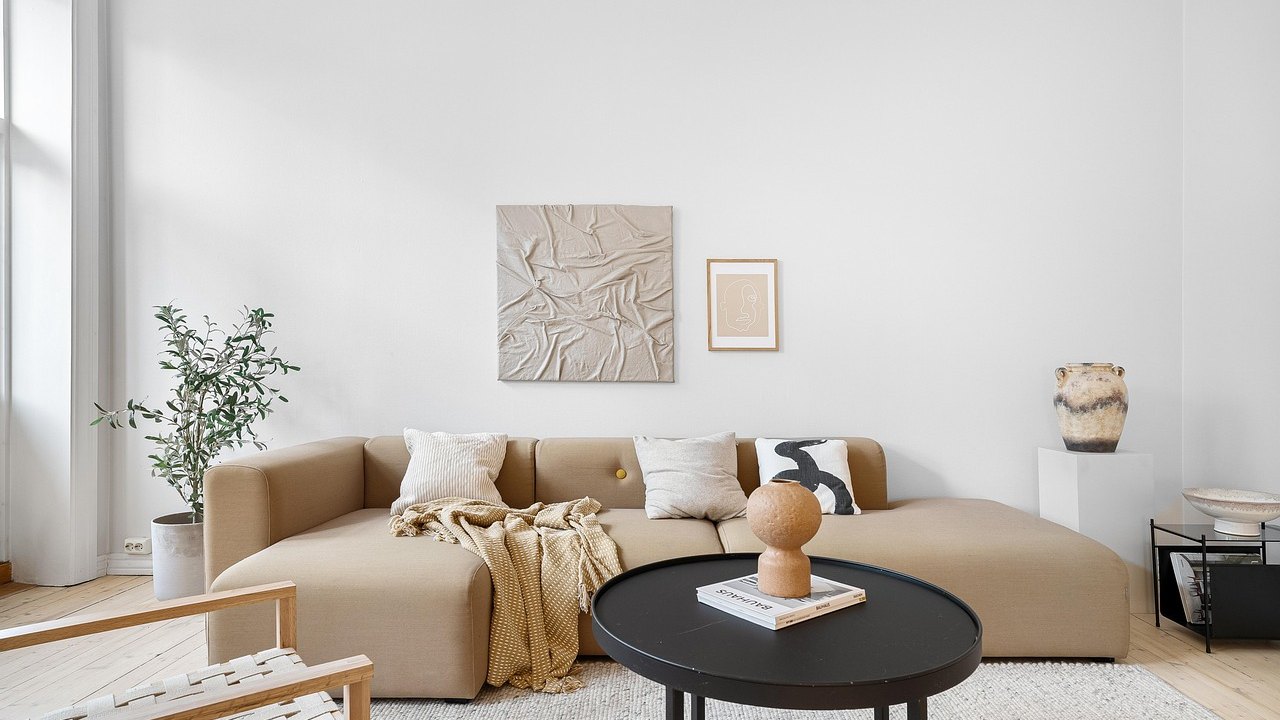
The most common wall in the developed world is the wall behind a television. It is roughly two metres wide, positioned directly opposite the main seating, and it is treated by its owners as a problem that has already been solved — the screen is the wall's content, and nothing else is required.
Then the television leaves. It breaks, or it moves to a bedroom, or you simply stop watching and take the thing to the recycling point. And you are left standing in your own living room looking at the biggest, emptiest surface in your home, with the sofa still pointed at it like a congregation whose church has closed.
That sofa is the tell. As long as the seating faces the wall, the wall has a vacancy: it was built to hold an image, and no image has arrived. The wall will not feel finished until the room itself stops being a viewing room.
First, turn the furniture
This is the step people skip, because it feels like a detour. Turn the seating away from the wall before deciding anything about the wall.
Two chairs and a sofa arranged around a low table — facing each other, angled inward — changes the room's programme from viewing to talking. The wall stops being the destination of every gaze. Once nobody is looking at it, the pressure on it drops immediately, and you can see it for what it is: a surface, not a stage.
If the room is small, angle one chair toward the window and let the street be the screen. A room with a view has never needed a wall to entertain it.
Then give the wall exactly one job
Emptiness is not the problem. Indecision is. A wall that carries a scatter of medium things — six small frames, a shelf of unremarkable objects, a plant that has stopped growing — is noisier than a bare one, because each item asks to be looked at and none rewards it.
The wall wants one of three jobs, and only one:
Background. Paint it one tone darker than the rest of the room — a warm neutral, not a flat grey, which reads institutional the moment the bulbs come on — and put nothing on it. A darkened end-wall makes a room feel deeper; it is the cheapest renovation that exists. This works when the room already holds things worth looking at: a good rug, one good chair, real light. If those exist, the wall needs exactly nothing, and adding to it will subtract from the room.
One large object. The single best occupant of a departed screen's wall is a mirror. A large one — eighty centimetres wide or more — bounces the window's light across the room, doubles whatever greenery is outside, and gives the wall a presence without any decoration at all. The alternative is one oversized frame, a print with some scale to it, hung at the height the screen used to occupy: centre at seated eye level, roughly. Not higher. The gallery-height instinct puts pictures above the sightline of a person sitting down, which is the only person who matters in this room.
A work surface. A low sideboard, doors not drawers, with a lamp and two objects on top and nothing hanging above it. The wall becomes storage rather than display — the most honest use of a wall in a small home, and the one that will still be useful when fashion has moved on from every other option on this list.
The sockets, and other archaeology
Every wall that held a screen has a second story underneath it: two sockets, an aerial point, a cable channel, and a patch of paint a shade lighter where the screen blocked the light for eight years.
Deal with the archaeology before you decorate, because every object you hang will otherwise be hung around a socket at the wrong height.
The sun-bleached patch is the most visible. Paint the whole wall rather than touching in — a patch never matches, because the surrounding paint has also aged, just less. If the wall is wallpapered, the honest move is to hang something large over the patch or repaper the wall.
The sockets are the useful part. Two at 30cm and an aerial at 90cm is a decent arrangement for a sideboard: the low ones take a lamp and a speaker, the high one can be covered by whatever hangs above. If there is a conduit running up the wall, it can be filled and sanded, or covered by a full-height mirror.
The aerial point is worth keeping even if you never use it. A coaxial cable is also a decent path for a network cable, and a future occupant will want it.
Then hang at the right height. The centre of a picture or mirror should sit at about 145–150cm from the floor — the standard gallery height, which happens to be roughly seated eye level plus a little. Above a sideboard, take the top of the sideboard, add 20–25cm, and put the bottom edge of the frame there. That gap matters: less and the object looks like it is resting on the furniture; much more and the two read as unrelated.
What the wall does not want
It does not want a gallery of small frames arranged in a shape on Pinterest. That arrangement reads as a display of effort rather than of anything on the wall. It does not want a television-shaped substitute — a projector screen, a giant digital photo frame — which is the same church with a new god. And it does not want three dimensions: a wall of floating shelves at eye level will collect exactly the clutter the television's departure was supposed to cure.
One last observation from rooms I have measured. People worry that a bare wall will make the room feel cold, and in my experience the opposite happens. A room with one deliberately quiet surface feels calm, and calm reads as warm. What makes a room feel cold is not emptiness — it is the sense that a decision is still pending.