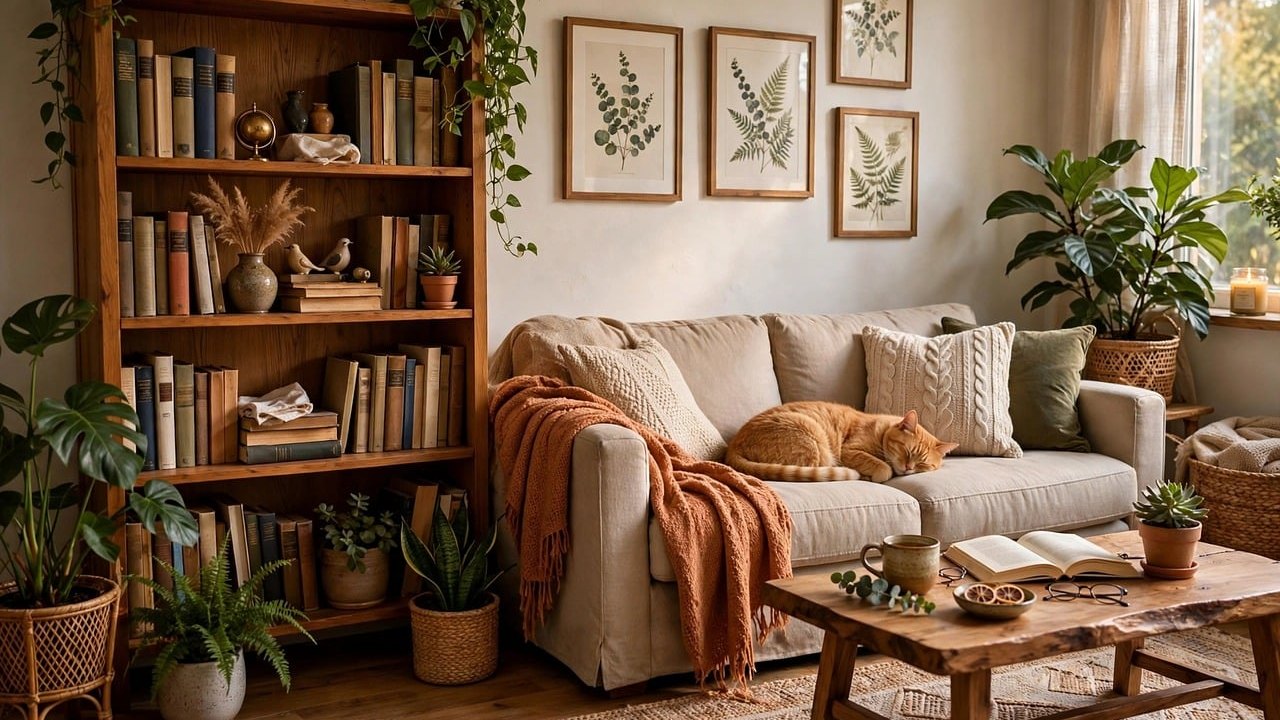
Open shelving is sold as a look. In photographs it is a look: a few ceramic bowls, a plant, a row of books with the spines facing the same way. In a house it is a permanent, uncloseable display of everything you own, and the decision to install it is a decision about your possessions rather than your taste.
That is not an argument against it. It is an argument for installing it deliberately.
What an open shelf actually does
A closed cupboard hides things and an open shelf classifies them. That is the real difference, and it has a practical consequence: open storage forces you to have a category for every object, because the shelf will not let an object be merely "in there."
This is why open shelving either looks wonderful or terrible and rarely in between. It is a mirror of whether the household has decided what it owns.
The rule that decides what goes on
Open for things that repeat. Closed for things that vary.
A set of six identical glasses repeats. A collection of twelve food packets varies — in colour, in typography, in size. Put the glasses on the shelf and the packets behind a door, and both look better.
The same rule explains why open shelving works so well for ceramics, books and glassware, and so badly for kitchen food, cleaning products, cables and children's toys. The first three come in sets; the last four come in a riot of packaging.
The corollary: if you cannot buy it in multiples, it does not belong on an open shelf. A single beautiful object is an exception, but a shelf of single beautiful objects is a collection of exceptions, and collections read as clutter.
Depth is the hidden variable
A 30cm shelf invites a second row. You put the things you use in front, the things you rarely use behind, and within a month the back row is invisible — which means it is storage you have paid for and cannot see, occupying wall space in the most visible place in the room.
A 20cm shelf holds one row and refuses the second. It is the single most useful specification on any shelf, and it is almost never printed on the box.
For books, depth matters less than span. A shelf spanning more than 90cm in 20mm board will sag under the weight of books within a year or two; 90cm with a 25mm board, or a support in the middle, will not.
Load, honestly
A floating shelf fixed into studs with proper steel brackets holds 20–30kg per metre. The same shelf fixed into plasterboard with hollow-wall anchors holds about 5kg, and it will sag visibly before it fails.
Books are the test case. A metre of hardbacks weighs 25–35kg. That is at or beyond the limit of a well-fixed floating shelf, and far beyond a badly fixed one. If the shelf is for books, it should either reach the floor or be fixed into studs with brackets you can see. A shelf that fails at 2am above a bed is not a design decision.
The empty third
Leave roughly a third of each shelf empty, and leave one shelf entirely empty if you can.
Not for minimalism — for the same reason a paragraph needs margins. Objects need space around them to read as individual objects. A shelf packed edge to edge becomes a texture, and texture is what people mean when they say a room feels busy.
The empty third also does something practical: it gives you somewhere to put things down. A shelf with no spare capacity is a shelf that cannot absorb a new book, a gift, or the thing you are carrying. So the new object goes on the table instead, and the table becomes the pile.
How to arrange a shelf so it stays arranged
The reason styled shelves look good in photographs and fail in houses is that the photograph is arranged by height and the house is arranged by use. The trick is to make those two things the same.
Build in threes, not in rows. Three objects of different heights read as a composition; five identical objects in a line read as inventory. Group them toward one end of the shelf rather than centring them, and let the other end stay empty.
Vary the height, keep the line. One tall thing, one medium, one low — a vase, a stack of bowls, a candle. The variety is what makes it look deliberate. But keep the bottoms of the objects in a horizontal line along the shelf, because a shelf where objects sit at different depths reads as accident.
Give every object a reason to be at the front. Anything you reach for weekly goes at knee-to-chest height, at the front. Anything above shoulder height or behind another object will not be used. If a shelf can only be reached with a step, it is not storage.
One thing that is not a thing. A small plant, a candle, a stone. This is the object that makes the shelf read as arranged rather than stored, and it is the one people leave out when they are worried about clutter — which is why worryingly uncluttered shelves look like a shop.
The test after a week. Take a photograph. Then look at it a week later without tidying first. If the composition has fallen apart, the arrangement fought the household, and the household always wins. Change what lives on the shelf rather than training the household.
The dust bill
Open shelves need dusting, and nobody calculates this before installing them.
A metre of open shelving holds about twice the dust of a closed cupboard, because the air moves across it freely. In a living room that is a cloth every week or two. In a kitchen, it is different: airborne grease from cooking settles on everything, and it is sticky, so it holds dust that a dry cloth will only smear.
Kitchen open shelving above or beside a hob is a weekly job with a degreaser. Kitchen open shelving away from the hob is a monthly job. If that amount of cleaning is not going to happen, the shelves will look bad within a year, and a bad-looking open shelf is more visible than a closed cupboard door would ever be.
One fix that works: keep open shelves away from the cooking zone. The shelf by the kettle or the shelf for everyday plates is fine. The shelf above the hob, holding the pans, is the one that fails.
When to choose closed
Choose closed storage when any of these is true: the room is a corridor you see in passing, the objects vary in packaging, the room is a kitchen or a bathroom where grease and steam settle, the household includes small children, or you have not yet decided what you own.
That last one is the honest one. Open shelving is a reward for having finished a decision, not a way of making it. If the shelf is installed before the decision, it will display the indecision — and you will spend the next two years buying baskets to put on it, which is the most expensive way to arrive back at a cupboard.