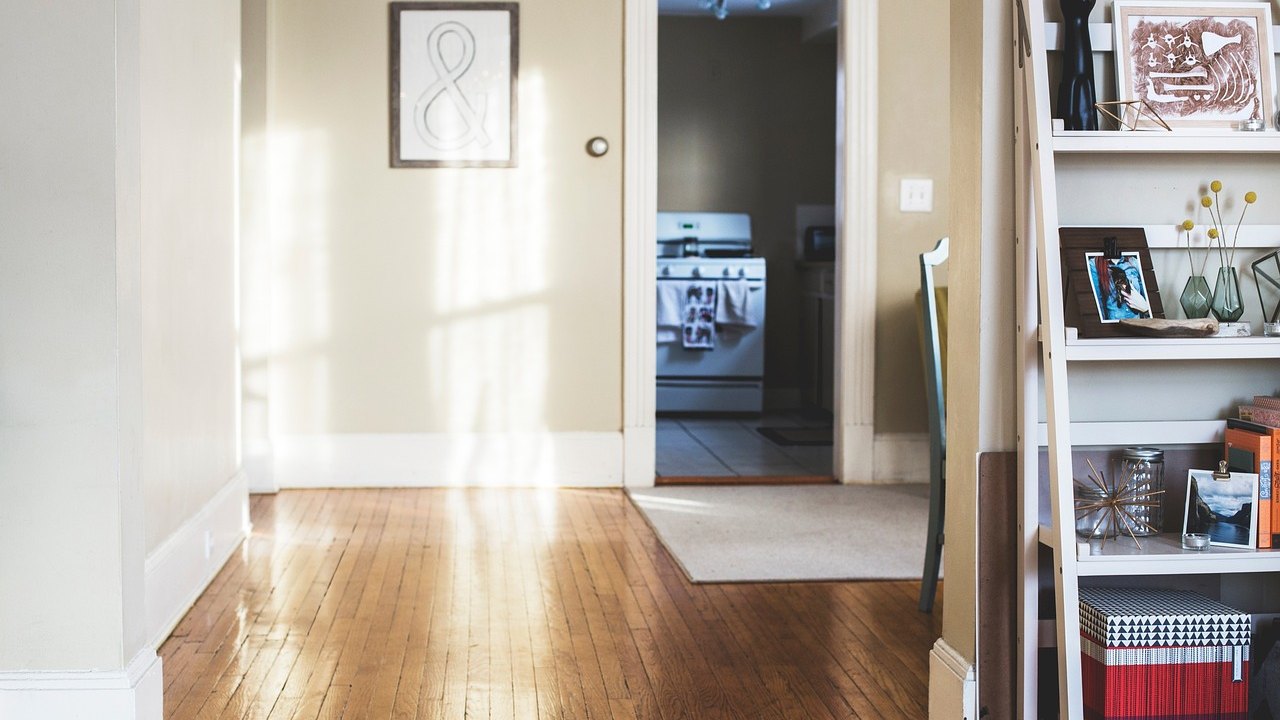
The hallway is where storage advice goes to die. It is typically four to six square metres, it has more doors than walls, it is the first thing anyone sees, and it is expected to hold coats, shoes, bags, keys, post, the dog lead, an umbrella, and whatever came in with you and has not yet been put away.
No cabinet solves that, because the problem is not capacity. The problem is that a hallway is a transit space being asked to do the work of a room.
Three jobs, not one
A hallway has three distinct storage jobs and they need three different answers, in three different places.
The arriving layer. Coat, bag, keys, the thing you carried in. This happens in the first two metres inside the door and it happens in about eight seconds. Anything that requires a door to be opened, a lid to be lifted, or a step to the side will not be used — and the object will land on the nearest flat surface instead.
The leaving layer. Shoes you wear this week, the umbrella, the lead. This is a smaller set than people think and it belongs at floor level, out of the walkway.
The overflow. Post, returns, the thing to be given to someone. This is not storage at all; it is a queue, and queues need to be emptied rather than stored.
Most hallways fail because all three get merged into one piece of furniture, usually a bench with baskets underneath, which then becomes a single undifferentiated pile.
The eight-second rule
Stand at your front door with your coat on and time how long it takes to put everything away.
If it takes more than eight seconds, you will not do it, and no amount of resolve changes that. This is the only measurement that matters in a hallway, and it explains why a beautiful closed wardrobe by the door sits empty while the coats hang off a chair.
The fix is almost always to reduce the number of operations. A hook is one operation. A wardrobe is three — open, hang, close — plus a decision about which side. Hooks win in hallways for the same reason they lose in bedrooms: they are fast and they show everything.
The numbers
Hooks at 170cm. Higher and long coats hang past the seat of a chair and the hems crease; lower and they pool on the floor. A second rail at 105cm for children, which they can reach from about four years old.
Shoe depth at 22cm. A pair of adult shoes is about 30cm long. In a 22cm-deep cabinet they sit at an angle, which is fine, and the walkway stays clear. A 40cm cabinet in a 100cm hallway removes the hallway.
One pair per person on the floor. Not the whole collection. A rack with eight slots will hold eight pairs, and eight pairs of shoes at a door is not storage, it is an obstacle course. The rest live in a bedroom cupboard, and the seasonal swap moves them.
A 30cm basket for overflow. Round, open, and emptied once a day. The daily emptying is the design: a basket that is never emptied is a drawer with worse ergonomics.
The floor has to survive grit
A hallway floor takes more abuse per square metre than any other surface in a house. Sand and grit from shoe soles is a mild abrasive, and dragged across a floor it does to wood and stone what sandpaper does, only slower and over years.
Wood is fine if it has a hard finish and a mat at the door. The mat is doing more work than the finish: two-thirds of the grit comes off in the first metre, and a coarse mat outside plus a softer one inside removes most of it. Re-oil a hallway floor twice as often as other rooms.
Tile is the practical answer if the hallway is the only route from a back door or a garden. Porcelain is impervious and almost unbreakable; natural stone is porous and will take a mark from wet shoes or a leaking umbrella. Either way, choose a matte finish — a polished hallway floor is a slip hazard with a wet coat on.
A runner is the option that looks best and needs the most care. It protects the floor beneath, it makes a corridor feel like a room, and it is the first thing to look tired because it is walked on constantly. Choose wool with a short pile, or a flatweave that can be taken outside and shaken. A runner with a long pile in a hallway becomes a matted strip within a year.
Whichever it is, it needs a lip at the door and something underneath that does not slip. A rug that slides on a hard hallway floor is the most common accident in a house.
Light it at the door, not the ceiling
Hallways are usually lit by a single pendant in the middle, which lights the middle and leaves both ends dark. That is backwards: the two ends are where people stand, look for keys, and take coats off.
Put a light above the door, or a wall light at 165cm beside it, switched at the door rather than at the far end. Then a second light above whatever the hallway contains — the coat hooks, the mirror, the cupboard. Two modest sources at head height beat one bright pendant every time, because a hallway is a corridor and light in a corridor should mark the ends.
If there is no socket and no wiring, a battery wall light with a motion sensor does the job and lasts months between charges. It is not a permanent answer, but a hallway where you can find your keys is worth more than a hallway wired correctly in three years.
What not to put in a hallway
Anything you would need to move to get through. This sounds obvious and it is the single most common failure. Measure the clear width — it should be at least 80cm, ideally 90cm — and treat that as fixed. Furniture goes in what is left.
Open shelving. A hallway is a corridor; you see it from an angle, in passing, in poor light. Open shelves there read as clutter even when they are tidy, because you never see them straight on. Closed doors, or nothing.
The ironing board, the vacuum, the Christmas decorations. Hallways are unheated or underheated, which makes them tempting for storage and bad for anything sensitive to damp or cold. They are also the first place a visitor looks, which makes them bad for anything you would rather not display.
A mirror and a hook on the same wall. The mirror will be behind the coats within a week. Mirror on one side, hooks on the other, or the mirror above the tray rather than above the coats.
The one upgrade worth doing
If the hallway has a cupboard — an under-stairs space, a shallow closet — the highest-return change is not shelving. It is light and a shelf at eye height.
A cupboard you can see into gets used. A cupboard you have to crouch into with a phone torch becomes a place things go to be forgotten, and then the coats migrate back to the chair. One LED strip on the underside of a shelf, one shelf at 150cm, and the same cupboard holds twice as much because you can find things in it.
That is the whole hallway. Hooks where you arrive, shoes at the floor, one basket for the queue, and a cupboard you can see into. Everything else is a decision about what you own, and that decision does not get easier with better furniture.